Choosing a Location
Wind measurement quality depends heavily on where the sensor is installed. Ideally, the anemometer stands higher than surrounding objects, exposed to free airflow from all directions, where the wind is not funneled or blocked by nearby obstacles.
A less-than-perfect placement is still worth it: it gives meaningful relative comparisons over time and accurate information about the prevailing winds at your location.
Typical home installation
For a house installation, the best location is usually above the roof ridge, mounted on a pole extending about 1.5 meters above the roof surface. This helps reduce turbulence caused by the roof itself.
Garden or field installation
For garden or open field installations:
- Install the sensor at least 1.5 meters above ground in an open area.
- Increase the height if there are nearby trees, fences, or buildings.
- The more open and elevated the position, the more representative the measurements.
Anchoring the mast
A simple and effective ground anchor is a length of steel angle driven into the soil, with the mast strapped to it using two hose clamps.
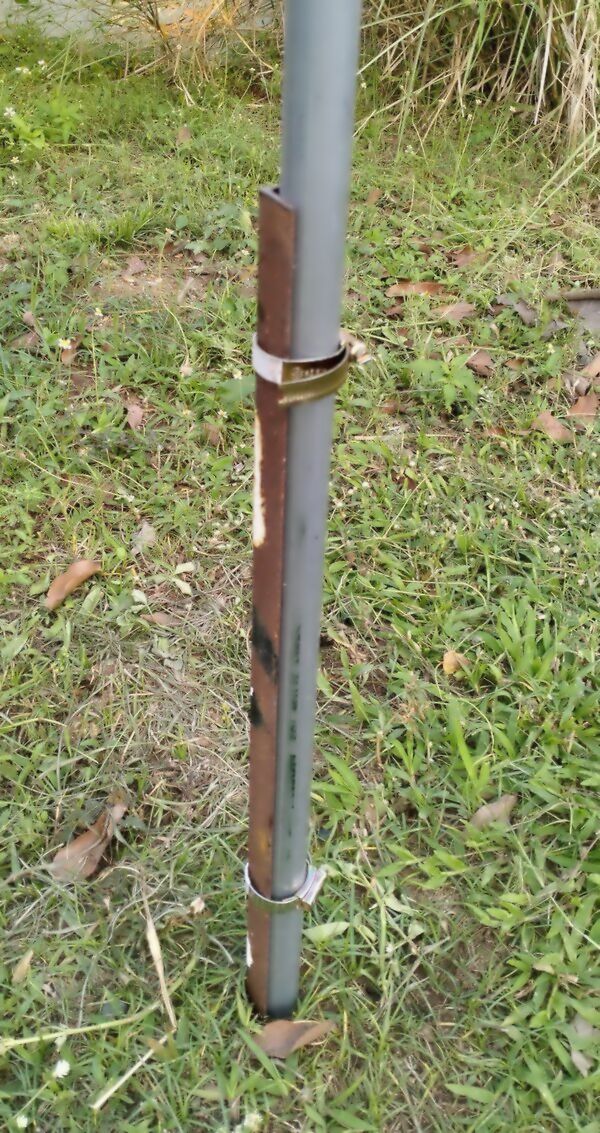
Hose clamps are a convenient way to attach a mast to an anchor or to an existing structure:
- Loosening the clamps lets you lower the mast to reach the anemometer for maintenance, then raise it back without disturbing the anchor.
- The clamps also allow you to rotate the mast to fine-tune the orientation of the anemometer, without having to do it from a ladder.
Mast and pole options
The lower part of the WindNerd anemometer can be printed in different sizes to fit over the top of a tube, pole, or mast between 10 mm and 50 mm in diameter.
Choosing the right support depends mainly on the desired height and on what materials are conveniently available to you. The main requirement is that the pole remains vertical and does not swing significantly during wind episodes.
Plastic pipe (PVC)
PVC electrical conduit or plumbing pipe is lightweight, inexpensive, and easy to work with. It is suitable for short installations, especially when mounted on top of an existing structure or along a wall using brackets. Recommended diameters: 35-40 mm up to 1.5 meters, 40-48 mm up to 2.5 meters.
Metal tubes
Metal tubes offer greater stiffness.
10-15 mm plain steel tube (painted)
- Suitable for short offset arms
- Can be bent to create a small horizontal extension away from a wall or mast
25-35 mm galvanized steel tube
- Suitable for vertical masts up to approximately 4 meters
- Good compromise between rigidity and weight
- Appropriate for most home installations
35-45 mm galvanized steel tube
- Suitable for heights up to approximately 6 meters (may require guy wires)
For safety, metal masts and poles should be properly grounded according to local electrical regulations, particularly in regions exposed to lightning.
Others
Beside raw materials, ready-made poles/mast or tubular structures can also be used or repurposed:
- Windsurf mast
- Flag mast
- Small boat mast or spar
- TV antenna mast
- Scaffolding tube
Once the location and pole are chosen, proceed to the Mast Installation page.